The Greeks
 What is God?
"That which has neither beginning nor end."
What is most difficult?"To know thyself."
What is most easy?"To give advice."
How might men live most justly and virtuously?"That we never do ourselves what we blame in others."
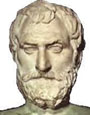
To summarize the natural theism of the Greeks, we could begin with Thales of Miletus (born 640 B.C.). He was a mathematician and astronomer. In his old age he was given the title sophos or sage and by common consent was named the first of the seven wise men of Greece. Thales believed that water was the first principle of all things, the form from which all things arise and to which they are destined to return. This proposal of a universal reductionism is an example of the monism from which we can directly trace our own knowledge of creation. Thales taught his students that every particle of creation is alive, that matter and life are inseparable and indivisible, that there is an immortal soul dwelling in all matter—stone, metal, animal and human—that vital energy changes form but never dies (paralleling the theme of creation). Thales taught there is no essential difference between living and dead.
Anaximander (611-549 B.C.) was Thales' most famous student. The first principle according to Anaximander was infinite, formless, boundless apeiron which develops through its inherent power into all of the realities of the universe. Today we call this God's wish or Love. God in Anaximander's system is this eternal, unvarying, impersonal One. The One God alone is real, and within this new worlds arise and fall through a struggle among elements. The words of The Awakener "Nothing is real but God" derives from an unbroken tradition of metaphysics of reality and illusion from the Greeks. Anaximander also described the laws of evolution in some detail, theorizing that land animals (including humans) evolved from the fishes in the sea.
The next generation of descent from Thales was Anaximander's pupil Anaximenes who held that the unifying principle was not water but air. The immortal soul is composed of air or pneuma, and this air is the very breath of God, the all-pervading spirit that holds the Universe together. Again, today we call this spirit Love.
We can move to the Ionian school and continue to trace the ancient Greek knowledge of evolution and reincarnation through Anaxagoras (born 500 B.C.) Anaxagoras professed a theory nous, or cosmic Mind which anticipated Meher Baba's imparting of knowledge of the mental plane and the mental body. This directly anticipates our understanding that karmic impressions are stored and carried in Mind through life after life. Anaxagoras conceived a World Mind, analogous to our Universal Mind, in the form of a vortex which guided the development of the physical forms and suggests a theory of reincarnation. It was this vortex of universal mind that was satirized in Aristophanes' play
The Cloud.
At the risk of his own life, Anaxagoras studied astronomy and developed a complex, brilliant description of the stars and planets including the belief that intelligent life existed on other planets. He also propounded a theory of evolution from the sea and noted that humans became dominant because our erect posture allowed us to use our hands for grasping things. Anaxagoras became caught up in the uprising against Pericles. He was brought up on a charge of impiety and fled Athens rather than drink hemlock.
Empedocles (born 490 B.C.) may have been an advanced soul on the involutionary planes. His work hints of the fourth plane. He was undoubtedly a genius. Aristotle credited him with "inventing" the principles of rhetoric. He was a brilliant engineer and freed the city of Selinus from pestilence by draining marshes and diverting streams. He was a learned physician and healer. He had an vital intimation of the Beyond God state. He believed all humans had once been gods but had forfeited this divine consciousness through a fall. He cried out, "From what glory, from what immeasurable bliss, have I now sunk to roam with mortals on the earth!" He claimed supernatural powers, performed magic rites, and was said to have raised the dead.

When Love or the tendency to combine is dominant, matter develops into plants, plants into animals and organisms take higher and higher forms. Just as transmigration weaves all souls into one biography, so in nature there is no sharp distinction between one species or genus and another . . . hair and leaves, the thick feathers of the birds and the scales that form on tough limbs, are the same thing.
Nature produces every kind of form and love unites. All higher forms develop from lower forms. Sometimes Love unites nature into monstrosities that perish through maladaption, sometimes into organisms capable of propagating themselves and meeting the conditions of survival.
The central focus of Empedocles' work was the evolution of forms and the reincarnation of souls across forms. In words strikingly similar to The Awakener's description of love as the longing inherent in all matter to break out of oneself, Empedocles elucidated his theory of evolution. He claimed to have vision of his past lives. He was deeply touched by the knowledge of transmigration and his poetry expressed that he had been "in bygone times, a young maiden and a flowering shrub; a bird, yes, and a fish that swims in silence through the deep sea." Based, apparently, on his experience of the transmigration of souls he condemned eating animal food as a form of cannibalism. Empedocles had a subtle knowledge of evolution and understood that love is the purposive power driving it. He described creation and the permanent struggle between the creative power of love and the destructive force of hate.
Empedocles saw God in everything. He saw God as the cosmos itself, as the life of all life and the mind of all mind. In a warning to those who rely upon the senses and the intellect, to those who think they have found the answer in genetics, including the scientific materialists 2500 years later Empedocles wrote:
"Weak and narrow are the powers implanted in the limbs of men; many the woes that fall on them and blunt the edge of thought; short is the measure of the life in death through which they toil. Then are they borne away; and what they dream they know is but the little that each has stumbled upon in wandering about the world. Yet boast they all that they have learned the whole. Vain fools! For what that is, no eye hath seen, no ear hath heard, nor can it be conceived by the mind of man"
In later years he became a preacher and prophet, obsessed with the theory of reincarnation. He traveled through Greece warning his countrymen to abstain from marriage, procreation and beans. Legend has is that after raising a woman from the dead he flung himself into the fires at Mt. Etna in order to die without leaving a trace. But the elemental fire betrayed him and flung back his metal slippers upon the crater's edge, as heavy symbols of mortality.
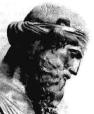
From India, the sweet perfume of Lord Ram wafted from Pythagoras and suffused Plato. Pythagoras was a brilliant numerologist and mathematician whose discoveries are still used today. Pythagoras professed the transmigration of the soul and used to amuse his followers with memories of his past lives. In one life he said he had been a courtesan, in another the warrior Euphorbus and that he could distinctly remember the siege of Troy.
More importantly, Pythagoras understood that the purpose of life is to gain release from reincarnation. He held that release from the rounds of death and birth was gained through virtue. Virtue is state of harmony within the soul and with God. Pythagorean training included quietude, serenity and calm happiness, what the Sufis call Zabta. Pythagoras tried to create harmony by using music, but told his followers that harmony more often comes to the soul through wisdom. The opposite way, the way of discord, excess and sin leads inevitably to tragedy and punishment. Justice is a "square number," and in the fullness of life after life, every wrong will be squared.
Perhaps the soul that has sinned goes to a purgatory or hell, the virtuous soul sojourns on the Islands of the Blest. When through various existences the soul has been purified of all wrong doing it is freed from reincarnation and mounts to a paradise of everlasting happiness.
Plato (born 427 B.C.) provided a metaphysics which was influenced by Hindu cosmology and included the five narratives of the theme of creation. Everything in Plato's metaphysics turned upon his theory of Ideas. Philosophy is the science of Ideas. God, the independent, prime mover and Soul of the World, moves and orders all things according to the eternal laws and forms, the perfect and changeless Ideas that constitute, as the neo-Platonists would say, the Logos or Divine Wisdom or Mind of God. The highest of the Ideas is the Good, which suggests our idea of Love. Sometimes Plato identifies this Idea with God himself. More often it is the guiding instrument of creation, the supreme form to which all things are drawn. To perceive this Good is the goal of knowledge. Creation is not merely mechanical, it requires a soul to experience its originative power.
Only that which has power is real, therefore matter is not real but is an ideal waiting for God to give it specific form and being. The soul is the self-moving force in man and is part of the self-moving Soul of all things. It is pure vitality incorporeal and immortal. It existed before the body and has brought with it from antecedent incarnations many memories which when awakened by new life are mistaken for new knowledge. Plato taught that all mathematical truth, for example is innate in this way; teaching merely arouses the recollection of things known by the soul many lives ago. After death the soul passes into another organism, higher or lower according to the desserts it has earned in its previous incarnations. This was mistaken. We now understand that it's always "a going forward." The soul does not revert to earlier forms (except in the extremely rare instance of the fourth plane). Each life expresses sanskaric impressions gathered in the previous life, with a brief intermission of the heaven or hell states between lives to either enjoy natural sanskaras or burn away unnatural sanskaras. But Plato was not far off.
While Aristotle (384-322 B.C.) did not expand the knowledge of evolution and reincarnation, his understanding of the soul intimated the planes of involution, the fourth narrative of the theme of creation.
Aristotle foretold of the gross, subtle and mental bodies, which were introduced by The Awakener some 2300 years later. The soul, according to Aristotle, has three grades: nutritive, sensitive and rational. Aristotle understood that as living forms evolve from animal to the human, the aspect of soul being expressed in the incarnation also progresses from nutritive through sensitive to rational. We now understand that the soul itself is changeless and beyond time. Gross sankaras are associated with the gross body, subtle sankaras with the subtle body, and mental sankaras with the mental body. Aristotle held that just as the soul is the form or entelechy of the body, God is the form or entelechy (or actuality) of the universe.