Curiosity: The Mysterious Compound
Curiosity is one of God's greatest achievements and one of humanity's best characteristics.
Love is the power to burst out of limitations and experience unity with other forms. Curiosity is a form of this power. It is the impulse, expressed through the intellect, to imagine the truth of something other than self.
Curiosity is the compound formed by imagination and longing. Like the divine Whim that permeates creation, curiosity exists in divine potential. Curiosity is a conscious experience of that potential.

From
Descent of Man by Charles Darwin, Chapter 3
All animals feel Wonder, and many exhibit
Curiosity. They sometimes suffer from this latter quality, as when the
hunter plays antics and thus attracts them; I have witnessed this with
deer, and so it is with the wary chamois, and with some kinds of
wild-ducks. Brehm gives a curious account of the instinctive dread,
which his monkeys exhibited, for snakes; but their curiosity was so
great that they could not desist from occasionally satiating their
horror in a most human fashion, by lifting up the lid of the box in
which the snakes were kept. I was so much surprised at this account,
that I took a stuffed and coiled-up snake into the monkey-house at the
Zoological Gardens, and the excitement thus caused was one of the most
curious spectacles which I ever beheld. Three species of Cercopithecus
were the most alarmed; they dashed about their cages, and uttered
sharp signal cries of danger, which were understood by the other
monkeys. A few young monkeys and one old Anubis baboon alone took no
notice of the snake. I then placed the stuffed specimen on the
ground in one of the larger compartments. After a time all the monkeys
collected round it in a large circle, and staring intently,
presented a most ludicrous appearance. They became extremely
nervous; so that when a wooden ball, with which they were familiar
as a plaything, was accidentally moved in the straw, under which it
was partly hidden, they all instantly started away. These monkeys
behaved very differently when a dead fish, a mouse, a living
turtle, and other new objects were placed in their cages; for though
at first frightened, they soon approached, handled and examined
them. I then placed a live snake in a paper bag, with the mouth
loosely closed, in one of the larger compartments. One of the
monkeys immediately approached, cautiously opened the bag a little,
peeped in, and instantly dashed away. Then I witnessed what Brehm
has described, for monkey after monkey, with head raised high and
turned on one side, could not resist taking a momentary peep into
the upright bag, at the dreadful object lying quietly at the bottom.
If the fuel of creativity is inspiration, the invisible engine of creativity is curiosity. It is the urge to know what will emerge from the mysterious compound. Curiosity is in essence a poetic engine. Science accumulates facts and information using intellect. But does science, especially paradigm-changing science, arise solely from intellectual machinations? Was Darwin's inspiration qualitatively different from Milton's? When Einstein published his three radical papers in 1905, where did those surprising notions come from? What is scientific or artistic surprise but a poetic moment in which God's timeless entrepreneurial wish, expressed as curiosity, becomes vividly conscious in the individual mind? Art and science languish without inspiration and curiosity.
Surprise is an excellent consequence of curiosity. A surprising way of looking at nature can happen after laborious reasoning or it can happen like a sudden breeze on a still day; it can happen in a laboratory or in a dream. Perhaps one way of judging a work of art is the potency of the surprise one feels even after it has become familiar.
Curiosity is latent in every evolving form, even before consciousness reaches full maturity in the human form with its fully developed subtle and mental bodies. I am not aware of say, a grub, displaying much curiosity, but anybody with a dog has seen amusing examples of curiosity in an animal.
Undoubtedly, scientific understanding advances and evolves. Humanity's knowledge
is continually adapting in the form of theories that better fit our observations. Thanks to our increasingly clever gizmos, our observations are on scales tinier and larger than scientists in Wilson's day could even dream. Language is invented to describe the new worlds and relationships that evolve from these observations. Similarly, art is continually evolving. Our four-dimensional ghazals are as far removed from the art in Old America as their photography was from prehistoric cave painting. But taken in themselves, such
advancements do not validate Wilson's purely biological view of knowledge or Darwin's somewhat dark inclination to view God as a consequence of natural selection. We have to keep in mind that everything in illusion is an approximation. Evolution in all forms of human expression, including the most inspired products of curiosity—science and art—is a game of successive approximations.
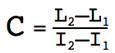
Tyler and Toy (2010) in their seminal bio-sanskaric
work
Never Mind, It's Not Matter, mapped curiosity
through the animal kingdom. They demonstrated how the acceleration of curiosity in primates
creates the sanskaric momentum for the leviathan leap in intellect in
human beings. Apes look timorously into boxes, humans invent herpetology. In
Never Mind, It's Not Matter they also proposed that curiosity can be measured like a classical velocity, with terms L (longing) and I (imagination).
Of course, in the evolutionary game things are sloughed off to make room for
more adaptive behaviors. Even forms of curiosity. A peculiar trait of Old Americans
was an obsession with time. They were always curious to know the time and there
were clocks everywhere. Everywhere. Today, we just are not curious about
what time it is.