Free Will
Meher Baba explained that everything that happens in creation is latent in the original whim and therefore inevitable. Everything that has ever happened in the millions of universes and everything that will happen in the endless millions of universes to come occurs as the result of infinite Divine ordering. So theoretically, taking this at face value, we can assume that randomness does not exist, and using something like Wilson's brand of reduction we could trace any event back through an infinitude of discrete causations through endless ages to the beyond beyond state of God to the original whim. The impediments to this monumental reverse journey through eterrnity are practical, not theoretical. The same impracticalities prevent us from traversing the infinite history to arrive at Wolfram's computational irreducibility. So I think we all agree that the ordinary human mind simply is incapable of grasping the complete history leading to an event in creation. However, for God, who is infinite knowledge, this piece of work ought not to involve work at all. But in fact in at least one case, infinite causality stumped even God!
I am so infinite that I myself cannot fathom my own Infinity. My shadow, the creation, is also so infinite that once I tried to count with my gross eyes all that had come out of me—all the universes—but I failed.
Baba's infinite mind can see the universes bubbling into illusion like evervescence in champagne, but is hapless when trying to count them. The millions of universes exist and vanish in an eternal flux kicked off by the original whim — and even God Himself cannot quantify them! So how can free will exist even theoretically? But at the same time, Baba often exercised His whim (or maybe it was the other way around) to, in effect, meddle in creation and redirect the inevitable. Meher Baba once said, "I have that one bad Avataric habit of supervising every detail myself!"
So we seem to be back where we started, with free will and determinism appearing to be opposite, irresolvable, and incompatibe terms in an inequality: 1 ≠ 0. Furthermore, they are not merely unequal, or even mutually exclusive concepts, they
eradicate each other. If 1 exists, then 0 cannot; if 0 exists, then 1 cannot. On the other hand, attempting to make them identical, 1 = 0, presents another logical barrier and perpetuates the schism. But we can begin to resolve this ancient conundrum if we stop thinking of free will and determinism as incompatible opposites. Theoretical opposites, to be sure, but not incompatible. This perspective is based on a re-examination and integration of two aspects of illusory time:
Time is a linear (and by logical extension, measurable) illusion in Reality. Reality cannot be fragmented, and therefore cannot be measured. In Reality, time does not exist. So the illusion of time contained in Reality, and everything that happens in illusory time, happens in the indivisible NOW of Reality, and all so-called ordering of events through time disappears. That is, the notion of Deterministic Event A in some linear manner preceding and leading to Event B is fundamentally false. The past is an aspect of time, which is the imaginary shadow of eternity in illusion.
Spontaneity. Everything in creation is a partial answer to God's initial question Who am I? That question was a whim. What is the nature of whim? Spontaneity. What is the nature of spontaneity? The perfect absence of a traceable cause. Spontaneity is what gives tensile strength to the weave of the physical (gross) universe. It is inseparable from creation. Why spontaneity expresses itself through individual human consciousness seems to be an irreducible mystery—perhaps even to God—but we can spot it when it happens. Free will is a kind of spontaneity. It is an instance of the whimsical nature of God finding expression through consciousness in illusion. Free will is an aspect of spontaneity, which is the shadow of timelessness in illusion.
We understand human actions, for example these words I am writing, as emerging from an infinite chain of causality stretching back to the initial whim, if not before. But this (for all practical purposes) infinite deterministic history does not obviate the existence of the free will motivating these thoughts. Free will is not a philosophical chimera or vain hope or illusion. The individual ego mind does make spontaneous choices outside a solely biological or otherwise physical deterministic chain of causation. An expression of free will is timelessly simultaneous with a unique and infinite causality as it is expressed. You might say free will, as a shadow of God's consciousness, spontaneously merges into its own unique, infinite destiny. But even here it is hard to get away from an implied linearity, because a shadow follows that which casts it, even if it is cast at an unimaginable velocity. Maybe it is better to leave the metaphor of shadow behind and think of free will as a conscious, essentially timeless moment when an individual mind intentionally embraces timelessness.
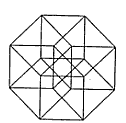
A hypercube shows how multiple possibilities can coexist simultaneously even though only one at a time is perceptually possible. The different configurations appear and vanish into each other in a linear manner, which allows only one configuration to be observable at any given moment. While it lasts in perception, the observed configuration appears to be independent and self-contained, but in fact it is just one of many simultaneous, inextricable, continuous, and indivisible events. All apparent sequential and isolated events occuring in linear time are like the transitioning hypercube configurations. They are provisional transitory "illusory realities" within an encompassing unbroken Reality. Another way to envision the coexistence of free will and determinism is to imagine the divisions of linear time as turbidities in solution in an unbroken medium. Reality may be infinitely independent but it is also infinitely miscible.
Why is love so important in all of this? Illusory time represents fragmentation. It follows that fragments can be measured. One mode of measurement is weight. A sanskara exerts weight in consciousness, although so unimaginably small it is beyond gross measurement. Reality is indivisible and in Reality there is no time. Reality cannot be fragmented and therefore cannot be "chunked off" and measured in weight. When free will is expressed as love, Reality is casting an instantaneous weightless shadow in illusion, and it cannot add sanskaric weight to illusion.
Whimsy permeates creation. In human beings, it is expressed as impulsive free will. At the most primitive level in the evolutionary chain of causation (the 276 weightless gases of the subtle world that comprise gross energy, known in physics as the quantum world), wave-particles change their states spontaneously and unpredictably without passing through intervening states. Quantum wave-particles transition from one state to another timelessly. This discontinuity is a fundamental precept of quantum physics. One way to understand this spookiness is primitive free will without consciousness.
Distribution & Magnitude of Free Will
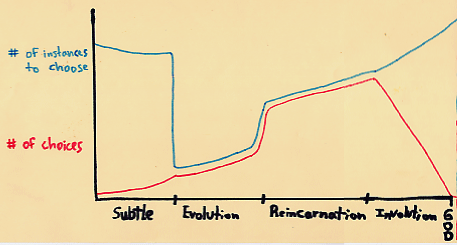
At the subtle level, energy (known as wave-particles in physics and the 276 weightless gases identified by Meher Baba) continually and spontaneously change state. This fundamental level of creation scintillates with these spontaneous and
timeless transitions. However, the number of possible state changes is very limited because they are solely functions of position and energy. At the evolution of forms (beginning with stone) the incidence of free will diminishes drastically. Beginning with vegetable forms, the illusory individual soul (jeevatma) begins to function as a kind of filter to express the sanskaras associated with that form. As the soul progresses through the relatively mechanistic evolution of forms, both scales keep pace with the developing consciousness. Arrival at the human form is accompanied by a dramatic leap in both the rate of incidence and the number of possible free will choices. Upon entering the path of involution, the rate of incidence again increases, but the number of possible free will choices sharply decreases. What accounts for this divergence? As the individual soul frees itself from binding and limiting sanskaras, its attenuated condition naturally allows more divine whim to seep through, but the possible choices, conditioned by purer and purer love, exclude ego-driven motivation and are therefore numerically reduced.
One final thought. Why couldn't Baba count all the universes? Why doesn't infinite knowledge encompass infinity? That is a question to ask the next Avatar—and a good reason to do science in the meantime.